Posted on

The Flatgoods Story

The Flatgoods Story Grand Rapids Mi

How did Flatgoods begin?
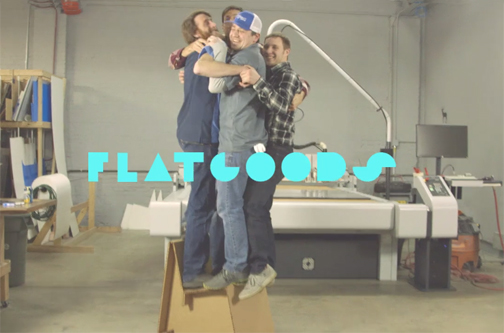
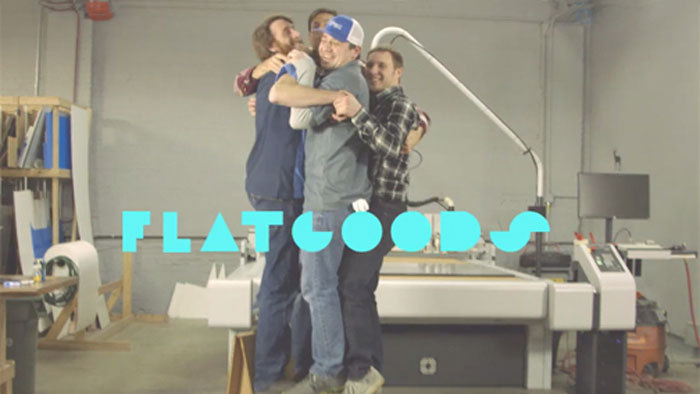
FlatgoodsThe founder of Flatgoods, James, started with an interest in graphics, signage, and colorful printing. He also founder and president of a signage company, Icon Sign–that means he is a long-time expert in industrial printers and routers. Because he already had this equipment available (and had a dream to do something better for the environment), James explored the possibilities of cardboard: the recyclable, bio-degradable, and printable building block of Flatgoods. Using some of the coolest cardboard out there (Falconboard, read more about it here), he and a few others began tinkering and designing, and decided to start Flatgoods: a brand specializing in printed cardboard furniture and displays.
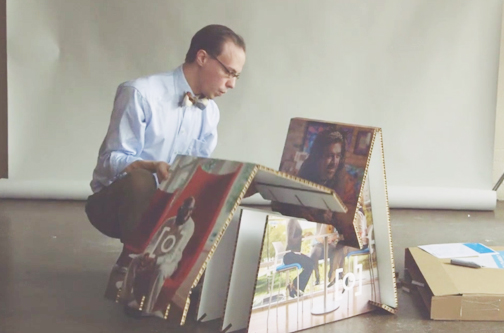
Guy Assembling

You might think that the leap from sign-making to furniture-making is a big one, but we’ve found an awesome overlap between the two realms. We’ve taken custom-printing from the sign world, and combined it with modern furniture shapes to make printable, sustainable, cardboard furniture.

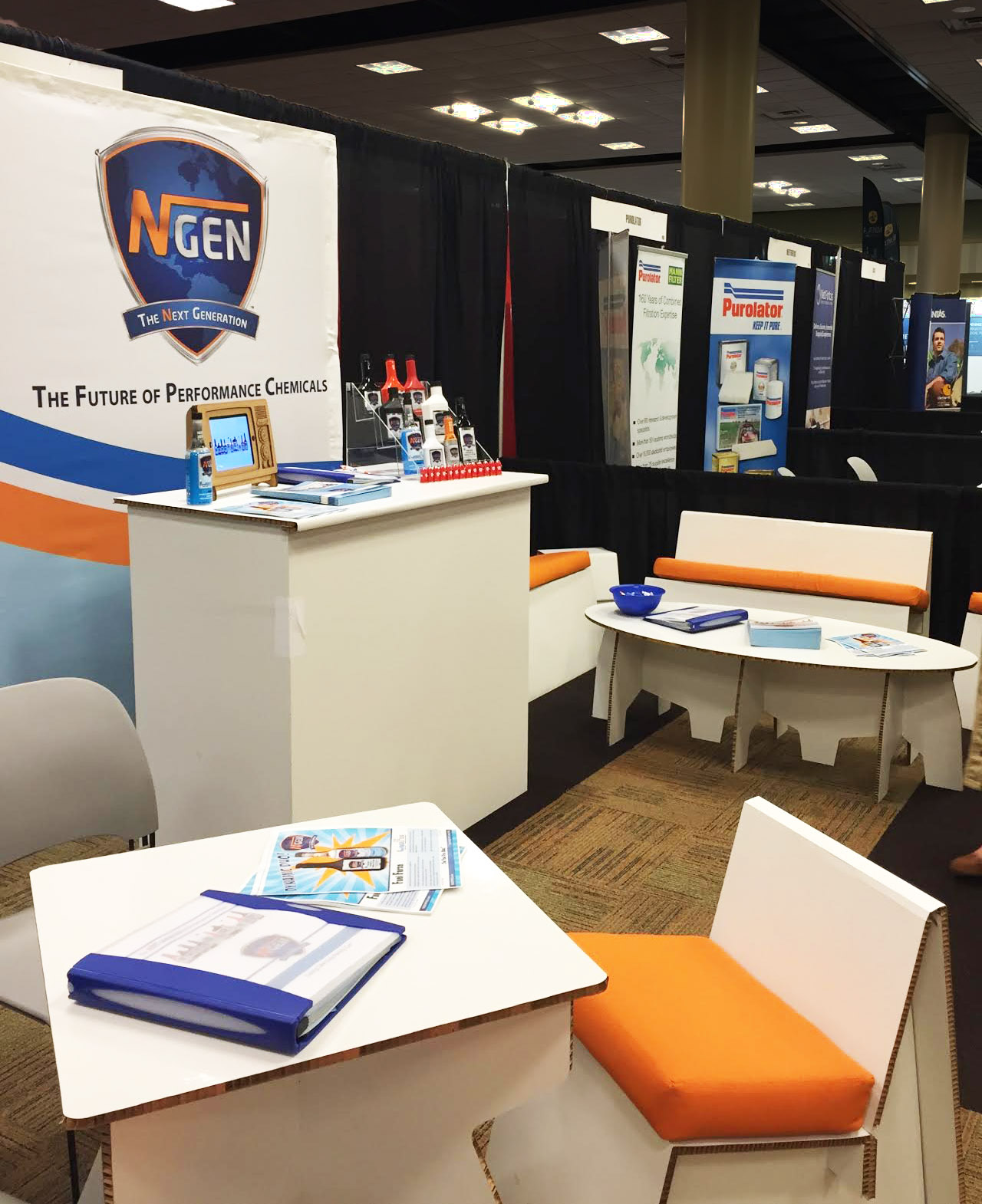
Our furniture is great for your home, your dorm room, your kids’ rooms, your office, or your tradeshow with your brand printed all over it. Seriously. Flatgoods perform beautifully in tradeshow and commercial settings. We make custom tradeshow backdrops, custom display racks or shelves, custom signs, custom… lots of things!

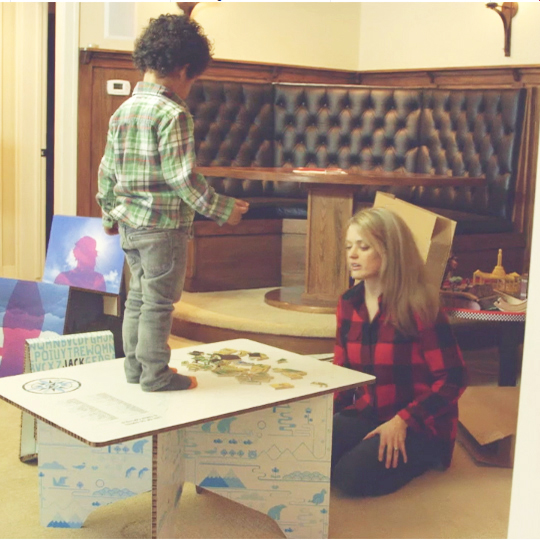
Our goals are tokid on table
      • Sell items that are affordable
      • Design items for flat, inexpensive shipping
      • Create a product that solves environmental problems

With the right type of cardboard and smart engineering, cardboard can be as strong as wood. But it’s printable and recyclable. What more could you want?
Watch our video here to see and hear more about us!

Posted on

A Cut Above The Rest: Designing With Flatgoods

Designing With Flatgoods Grand Rapids Mi

Designing With Flatgoods Grand Rapids Mi
Deksia, a brand strategy firm based in Grand Rapids, was tasked with developing a tradeshow booth for one of their clients, Chop. With the budget provided, creative director Josh Ryther and senior designer Jeremiah Elbel would normally have been limited in their production options for the tree service company. Fortunately, Flatgoods’ low-cost, high quality service allowed them to achieve their goals, and then some.

“We wouldn’t have been able to do anything for the same price (somewhere else). It would have cost three times as much to do,” Ryther said. “With Flatgoods, we were able to design a fully immersive experience that subtly changes your sense of place, which is really hard to do in a 10 x 10 booth. It gave us the opportunity to really draw attention to the brand.”

A three-panel booth was designed, with each panel featuring an education point relating to Chop’s services. “We designed it with Flatgoods in mind. We hadn’t really designed much with them, so we had to devise the structure. But we knew Flatgoods was capable of building anything we could imagine,” Ryther said.

With the low cost of production, Deksia realized they’d have money left over to make something special. “We decided to create a table to go in the center of the booth,” explains Elbel. “We made it bright red, which complimented the whiteness in the backdrop. It really helped create an atmosphere.”

Both Deksia and Chop were extremely pleased with the final product.

“Not only was the solution cost effective, but the actual product itself connected with the values of the company,” Elbel said, referring to Flatgoods’ premium, sustainable cardboard material.

“I think a booth of this caliber builds trust with consumers when they see it,” Ryther said. “It’s extremely professional and extremely forward thinking. It makes an impression, and it wouldn’t have been possible without Flatgoods.

Posted on

Sustainable Business Is Better Business

Designing With Flatgoods Grand Rapids Mi

Sustainability in business practices has become increasingly important to consumers in recent years. As the public becomes more informed regarding the environmental impact of manufacturing, many are making a greater effort to support companies that employ environmentally conscious practices. At Flatgoods, utilizing a sustainable business model is at the core of what we believe. Below you’ll find facts that demonstrate the amount of waste produced through normal activity, the positive effects that can result from sustainable living, and how businesses are making conscious decisions to improve both their environmental footprints and their bottom lines.

WASTE FACTS:

  • Every year, Americans throw away enough paper and plastic cups, forks, and spoons to circle the equator 300 times. (cleanair.org)
  • Ninety-five percent of our solid waste is disposed of in almost-filled landfills – and one out of every two of those landfills desperately needs repair to avoid leakage. (green-networld.com)
  • Every year, Americans use approximately 102.1 billion plastic bags, creating tons of landfill waste. (cleanair.org)
  • Americans produce enough Styrofoam cups every year to circle the earth 436 times. These cups are completely non-biodegradable, deplete the Earth’s ozone layer, waste enormous amounts of landfill, and are deadly to marine life. Ceramic mugs cost a few dollars. (sustainablelafayette.org)

RECYCLING FACTS

  • One recycled bottle saves enough energy to run a 100-watt light bulb for four hours. It also causes 20% less air pollution, and 50% less water pollution than making a new one. (bc.edu)
  • If every American recycled one-tenth of their newspapers, we would save 25,000,000 trees per year. (bc.edu)
  • Recycling a soda can saves 96 percent of the energy used to make a can from ore and produces 95 percent less air pollution and 97 percent less water pollution. (mit.edu)
  • Recycling one ton of cardboard saves over nine cubic yards of landfill space. (mit.edu)

SUSTAINABLE BUSINESS FACTS

  • Sustainability offers innovative firms opportunities for both top and bottom      line benefits. New companies and brands have been created that are entirely green-focused, such as Seventh Generation, Clorox‘s GreenWorks, and Motorola‘s Renew mobile phones. Not only are these brands bringing in millions in revenues, they are also enhancing the brand image of their parent companies. (greenbiz.com)
  • GE launched its ecomagination initiative in 2005; by 2011, the company had sold $70 billion of green products and services, with $25 billion of that in 2010 alone. GE has committed to doubling its investment in its green offerings to $2 billion a year for the next five years. (environmentalleader.com)
  • Walmart is investing aggressively in energy and fuel efficiency. The $500 million it’s investing in sustainability projects have a payback of four years or less and has become an incredible profit engine for the corporation. Walmart embarked on this initiative in 2005 and is now saving more than $500 million a year – all of which is driven to the bottom line. (environmentalleader.com)